

Date: September 21, 2026 | 4 Min Read
Summary
Date: September 21, 2026
4 Min Read
AI is now part of everyday agency work. Teams use it to review websites, surface SEO observations, scan content, and speed up decision-making. In many cases, that speed is useful. It helps teams begin investigations earlier and gives them more material to work with.
But speed has created a new problem. One of the most common AI audit mistakes for agencies is assuming that a long, technical-looking report must also be accurate. The moment that assumption takes over, the audit stops being a helpful starting point and starts becoming a source of unnecessary pressure.
The issue is not that AI should be avoided. The real issue is that AI can create urgency before clarity, especially when nobody has properly reviewed what the report is actually saying. That matters even more for agencies already juggling delivery, communication, and trust. If your workflow depends on white-label execution and technical support, this becomes an operational issue as much as a technical one.
Why AI-Generated Audits Can Mislead Agencies
AI-generated audits often look convincing because they are structured, detailed, and confident in tone. When a report is presented clearly, people naturally give it more authority. That is where the first mistake begins.
A polished report is not the same as a verified report. In agency work, a finding only matters if it is accurate, relevant to the project, and worth acting on. Without that filter, teams can end up reacting to noise instead of reality.
This matters especially in areas like search engine optimization, where a technical-sounding issue can quickly feel urgent. But even Google’s own SEO Starter Guide and Google Search Essentials make it clear that websites should be evaluated with context, clarity, and people-first standards rather than assumptions.
A Real Example From the Scipio Creek Project
Last week, I was working on a project called Scipio Creek. The website had already been developed, and then Suzanne from the agency side sent over a document listing 135 issues. My first reaction was surprise, because there should not have been that many real problems on the site.
Naturally, the document looked serious. It was long, technical, and structured in a way that made it feel authoritative. The report had been created by sharing page source code with AI and asking it to audit the website for SEO issues and content-related problems.
Instead of assuming the report was fully correct, I reviewed it carefully.
That changed everything.
Out of the 135 flagged issues, only 4 were actual bugs. The rest were hidden template content, repeated elements being counted more than once, structural or design choices treated like errors, items that had already been fixed, or findings that needed context rather than correction.
That is exactly why this topic matters. What first looked like a major technical problem turned out to be a much smaller and more manageable situation. The biggest issue was not the site itself. The biggest issue was how much weight the AI-generated report seemed to carry before it had been properly reviewed.
The Most Common AI Audit Mistakes for Agencies
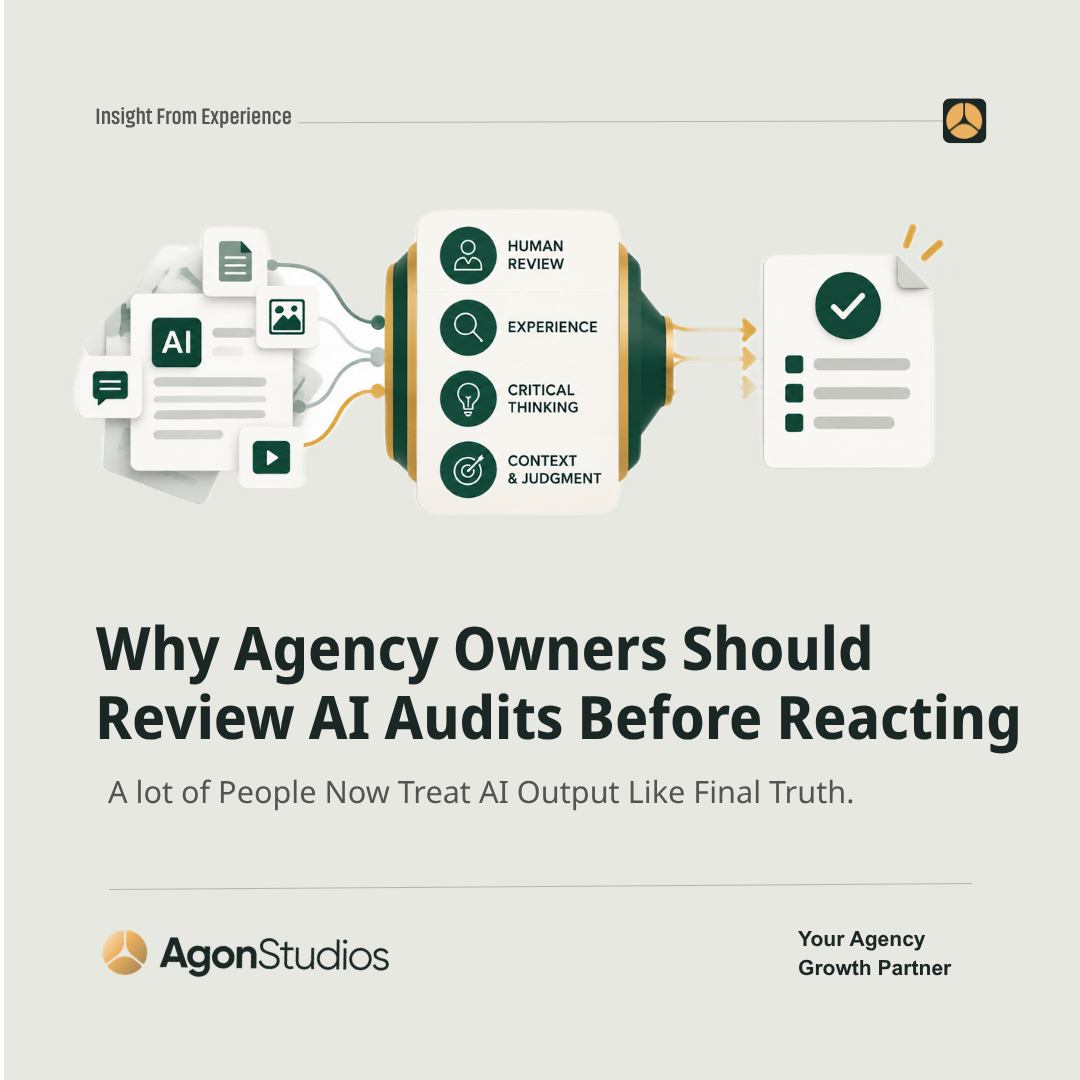
One of the biggest mistakes agencies make is treating AI output like final truth. A report arrives, the tone sounds confident, and the team begins reacting before anyone has checked whether the findings are genuinely meaningful.
Another mistake is confusing volume with severity. A long audit can make a project feel unstable, even when many of the issues are minor, duplicated, or not worth action. Once that happens, teams can waste time fixing the wrong things while more important priorities lose attention.
A third mistake is skipping context. AI can surface patterns, but it does not understand the full business, design, client, or platform decisions behind a site. Agencies still need someone to interpret what matters, what does not, and what should be handled first. This is one reason broader frameworks around human oversight, such as the NIST AI Risk Management Framework, keep emphasizing judgment, review, and clearly defined human responsibility.
The final mistake is letting AI weaken judgment over time. If teams get used to accepting reports too quickly, they stop practicing the kind of calm review that good agency work depends on. Instead of analyzing, they begin forwarding. Instead of interpreting, they begin assuming. NIST also expands on this in its guidance on AI risk management and human-AI interaction, especially around the role of human oversight in decision-making.
What Agency Owners Should Do Instead
A better approach is to treat AI as a tool for surfacing possibilities, not confirming conclusions. An AI audit should begin a conversation, not end one.
That means someone still needs to review the findings, remove duplication, filter out noise, and decide what is genuinely important. Without that step, even a healthy project can begin to feel unstable simply because the report sounded more serious than the reality.
This is also where a strong white-label partner becomes especially valuable. A good white-label partner does more than complete technical work. They help the agency interpret what is actually happening. They bring context before action, reduce false alarms, and help separate signal from noise. Agencies exploring AI solutions or scaling through WordPress solutions still need that human review layer if they want better decisions instead of faster confusion.
For agency owners, that matters because clients do not just need fast answers. They need clear answers. And clear answers only come when judgment stays stronger than urgency.
The agencies that benefit most from AI will not be the ones who trust it the fastest. They will be the ones who know how to question it, review it, and use it without giving up their own thinking.
That is what protects quality. That is what protects trust. And that is what keeps AI useful instead of disruptive.
If AI is part of your workflow, make sure your process leaves room for review before reaction. Speed can be helpful, but judgment is what protects the relationship. And if you want help building a more reliable delivery process behind the scenes, let’s talk.
Hi! I'm Kazi. I Help Agencies Grow and Deliver Big Results.
I help small agencies across the US and Europe deliver world-class websites, without the overhead of hiring in-house.
Here's what we do:
- WordPress Development (Pro Theme & Divi specialists)
- UX/UI Design (documentation-first, conversion-focused)
- SEO Services (white-label reports your agency can resell)
- AI Solutions
Ready to stop juggling freelancers? Start a Partnership and see how we work.